Introduction to Anti-Money Laundering (AML) Risk Management in the UAE
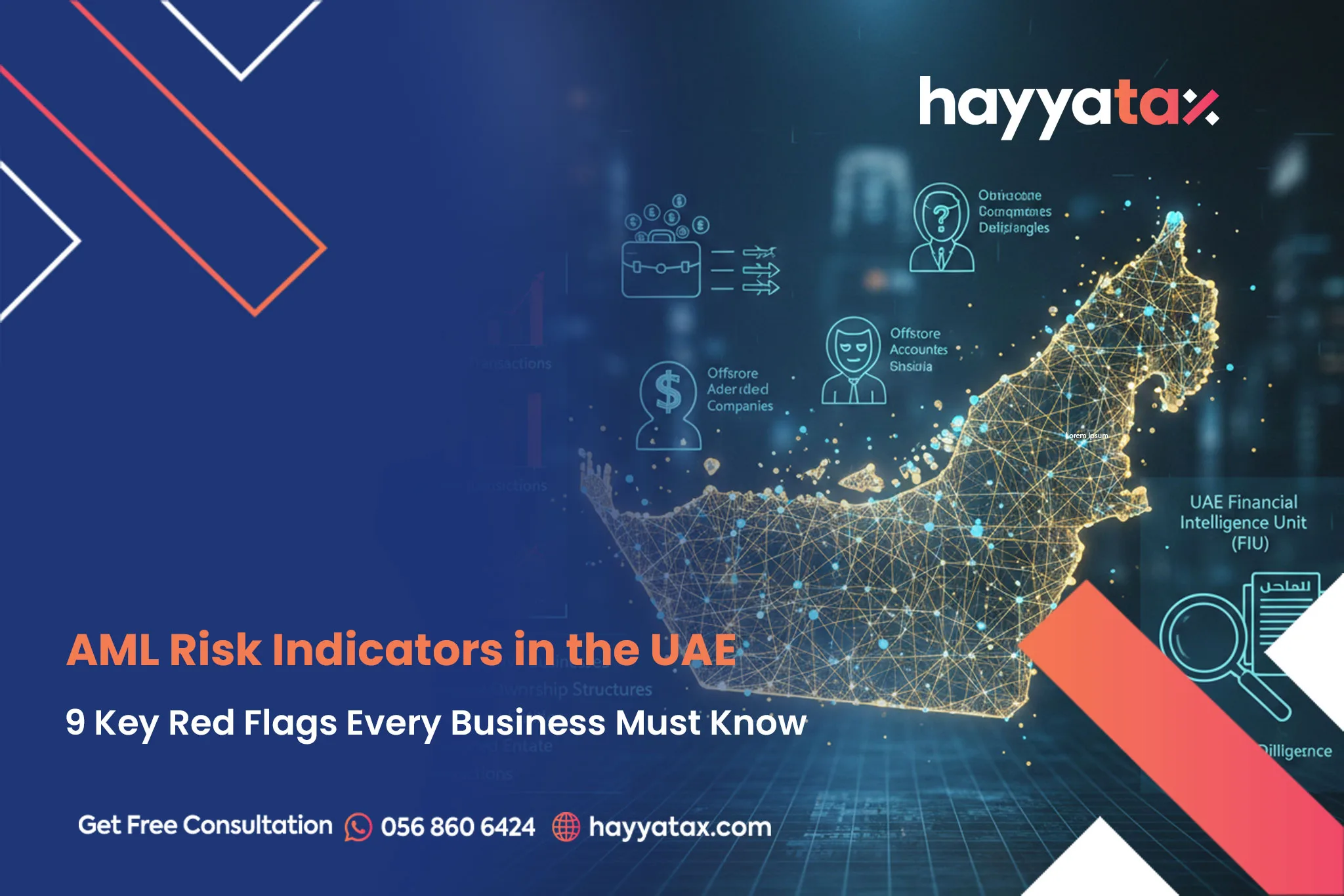
AML Risk Indicators in the UAE are critical warning signs that help businesses identify potential money laundering and financial crime risks, enabling early detection, regulatory compliance, and operational protection.
Money launderers constantly evolve their methods to disguise the origin of illicit funds and integrate them into legitimate financial channels. As a result, UAE businesses—particularly financial institutions and designated non-financial businesses and professions (DNFBPs)—must remain vigilant in identifying Anti-Money Laundering (AML) risk indicators.
Regulatory oversight by authorities such as the Federal Tax Authority (FTA) and other competent bodies emphasizes a risk-based approach to AML compliance. At HayyaTax, we help organizations recognize early warning signs and implement robust AML frameworks to reduce legal, financial, and reputational risk.
Why AML Risk Indicators Matter for UAE Businesses
AML risk indicators—also known as red flags—are observable patterns or behaviors that may suggest potential money laundering or related financial crimes. Identifying these indicators early allows businesses to:
- Prevent misuse of their services
- Meet UAE AML/CFT regulatory obligations
- Avoid severe penalties, fines, and license suspension
- Protect brand reputation and stakeholder trust
With billions of dollars in illicit funds moving through global financial systems annually, failure to detect and report suspicious activity can expose UAE businesses to significant regulatory enforcement.
The Impact of Money Laundering on UAE Businesses
Money laundering can affect organizations across multiple dimensions:
- Financial Integrity: Undermines transparent and lawful financial operations
- Legal Exposure: Results in regulatory penalties, fines, or criminal liability
- Reputational Damage: Erodes trust among customers, partners, and regulators
- Market Distortion: Creates unfair competition and economic inefficiencies
- Operational Costs: Increases compliance, remediation, and audit expenses
UAE regulators expect businesses to actively mitigate these risks through effective AML controls.
Key AML Risk Indicators in the UAE for Businesses
Customer Behavior AML Risk Indicators in the UAE
Suspicious customer behavior is often the first signal of potential financial crime. UAE businesses should exercise caution when customers:
- Are reluctant or refuse to provide standard identification or KYC information
- Demonstrate excessive secrecy about business activities or ownership
- Cannot clearly explain the source of funds or wealth
- Use complex or opaque ownership structures without commercial justification
- Conduct transactions inconsistent with their stated business profile
- Avoid face-to-face meetings or direct communication
- Use anonymous or untraceable contact details
- Submit altered, inconsistent, or suspicious documentation
- Resist routine compliance checks
- Maintain known associations with individuals linked to criminal activity
These behaviors warrant enhanced due diligence (EDD).
2. Transaction & Counterparty AML Risk Indicators in the UAE
Transaction patterns often reveal anomalies that require closer scrutiny, such as:
- Transactions involving high-risk jurisdictions identified by the Financial Action Task Force (FATF)
- Transfers with no clear economic or commercial rationale
- Complex transaction structures designed to obscure fund origins
- Payments directed or controlled by undisclosed third parties
- Unusual involvement of intermediaries without legitimate purpose
- Sudden spikes in transaction volumes inconsistent with customer history
- Urgent requests to complete transactions without reasonable explanation
Such indicators should trigger immediate internal review.
Implementing Effective AML Monitoring Procedures in the UAE
When AML risk indicators are detected, UAE businesses should follow a structured and defensible response process:
Document Observations
Record the specific behaviors or transactions that triggered concern.
Apply Enhanced Due Diligence (EDD)
Collect additional information on:
Beneficial ownership
Source of funds and source of wealth
Transaction purpose
Conduct Objective Risk Assessment
Evaluate whether suspicion is reasonable based on facts and regulatory guidance.
Determine Reporting Obligations
Assess whether filing a Suspicious Transaction Report (STR) is required under UAE AML regulations.
Implement Risk Mitigation Measures
This may include transaction restrictions, account monitoring, or relationship termination.
Financial institutions and DNFBPs are expected to integrate these steps into their risk-based AML frameworks.
AML Compliance Expectations in the UAE
UAE AML regulations require businesses to:
- Maintain up-to-date AML policies and procedures
- Conduct customer due diligence (CDD) and EDD
- Identify and verify beneficial ownership
- Monitor transactions on an ongoing basis
- Report suspicious activities to relevant authorities
- Maintain records for regulatory inspection
Regulatory bodies, including the FTA, actively monitor compliance and may impose sanctions for failures.
The Role of the Federal Tax Authority (FTA) in AML Compliance
While primarily responsible for tax administration, the FTA plays a crucial role in strengthening financial transparency in the UAE by:
- Enforcing compliance among tax-registered businesses
- Sharing information with other competent authorities
- Supporting national AML and counter-terrorist financing objectives
Tax compliance, transparency, and AML obligations are increasingly interconnected, making coordinated compliance essential.
How HayyaTax Supports AML Compliance in the UAE
HayyaTax provides end-to-end AML advisory services tailored to UAE regulatory requirements and international best practices. Our compliance specialists understand the evolving AML risk landscape and regulatory expectations.
Our AML Services Include:
- AML risk assessments and gap analysis
- Development and review of AML/CFT policies and procedures
- Customer due diligence and beneficial ownership frameworks
- Transaction monitoring guidance
- Staff training on AML risk indicators and red flags
- Support with Suspicious Transaction Reporting (STR) obligations
- Ongoing compliance and regulatory advisory
We help businesses remain audit-ready, compliant, and protected from financial crime exposure.
Conclusion
Understanding and identifying AML risk indicators in the UAE is no longer optional—it is a regulatory necessity and a critical component of responsible business operations. Early detection, combined with effective internal controls, significantly reduces exposure to legal, financial, and reputational risks.
With increased regulatory scrutiny and global information sharing, UAE businesses must adopt proactive AML strategies supported by experienced advisors.
Strengthen Your AML Compliance with HayyaTax
📌 Contact HayyaTax today for expert AML advisory services designed to protect your business and ensure full UAE regulatory compliance.
🌐 Visit: www.hayyatax.com