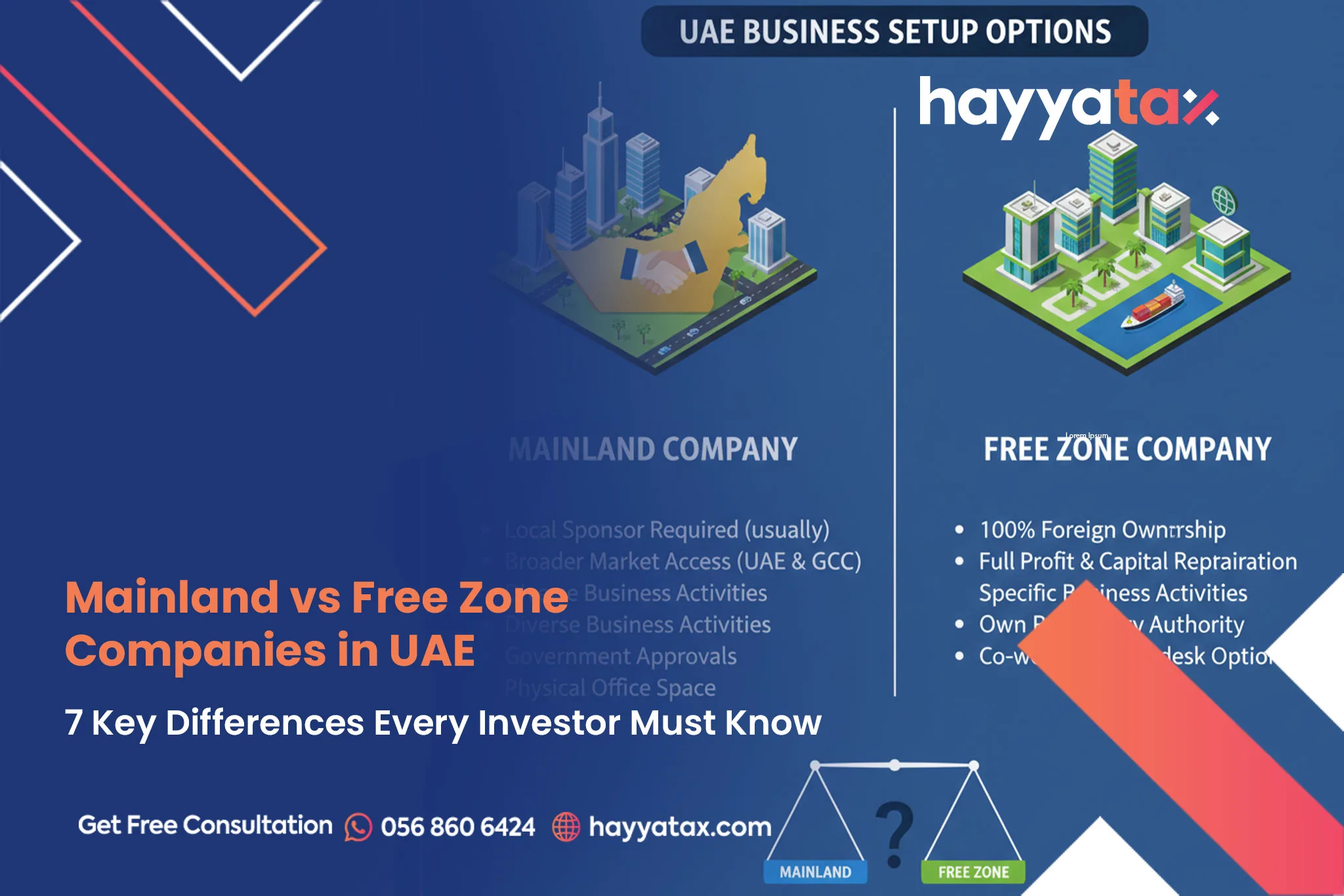
Mainland vs Free Zone Companies in UAE is one of the most important comparisons investors must understand when setting up a business, as the chosen jurisdiction directly impacts ownership, market access, taxation, and long-term growth.
Many entrepreneurs and foreign investors are initially confused by the differences between these two business structures. At HayyaTax, we believe that a clear understanding of UAE company jurisdictions is essential before making any investment decision. This comprehensive guide explains the key differences between Mainland vs Free Zone companies in the UAE, helping you choose the most suitable structure for your business goals.
Understanding Mainland vs Free Zone Companies in UAE
The UAE offers multiple jurisdictions to encourage investment, innovation, and economic growth. The two most common and practical options are:
- Mainland companies, regulated by local emirate authorities
- Free Zone companies, regulated by independent Free Zone Authorities
Each structure is designed for different business models and target markets.
What Is a UAE Mainland Company?
A UAE Mainland company is a business entity licensed by the Department of Economic Development (DED) of the emirate where the business is registered (such as Dubai, Abu Dhabi, or Sharjah).
Key Characteristics of Mainland Companies
- Can conduct business anywhere in the UAE
- Can trade freely with government entities, private companies, and individuals
- Allowed to operate both locally and internationally
- Eligible for unlimited visas (subject to office size)
Ownership Structure
Recent legal reforms allow 100% foreign ownership for most mainland business activities. Emirati ownership is still required only in a few regulated sectors, such as:
- Law firms
- Audit firms
- Educational institutions
- Certain government-related activities
This reform has made mainland company formation significantly more attractive to foreign investors.
What Is a Free Zone Company in the UAE?
A Free Zone company is established within a designated economic zone governed by a Free Zone Authority. Each free zone operates under its own regulations and licensing framework.
Key Characteristics of Free Zone Companies
- 100% foreign ownership guaranteed
- Simplified company formation procedures
- Attractive tax incentives and exemptions
- Designed mainly for international trade, services, and holding activities
However, Free Zone companies have limitations when it comes to direct mainland business.
Key Differences Between Mainland vs Free Zone Companies in UAE
Understanding these differences is critical for choosing the right structure.
1. Ownership Structure
Free Zone Companies
- Offer 100% foreign ownership across all permitted activities
Mainland Companies
- Allow 100% foreign ownership for most activities
- Emirati ownership required only for limited regulated sectors
From an ownership perspective, both options are now highly favorable to foreign investors.
2. Business Scope & Market Access
Free Zone Companies
- Can operate within the Free Zone and internationally
- Cannot directly trade with the UAE mainland
- Must appoint a local distributor or commercial agent to sell goods in the mainland
Mainland Companies
Can trade freely with:
- Mainland businesses
- Free Zone companies
- International markets
- Government entities
For businesses targeting the local UAE market, a mainland company is usually the better choice.
3. Banking Facilities & Corporate Accounts
Mainland Companies
- Generally enjoy faster and smoother bank account opening
- Benefit from stronger local presence and work-premium classification
- Easier compliance with bank KYC requirements
Free Zone Companies
- May face longer banking approval timelines
- Subject to enhanced due diligence by banks
- Banking requirements vary by Free Zone
If banking speed and flexibility are critical, mainland companies often have an advantage.
4. Company Formation Process
Mainland Companies
- Require physical presence in the UAE during formation
- Alternatively, a Power of Attorney (POA) can be used
- POA must be notarized and attested through the Ministry of Foreign Affairs
Free Zone Companies
- Formation can usually be completed without physical presence
- Fully remote setup possible in many Free Zones
This makes Free Zones attractive for overseas entrepreneurs starting remotely.
5. Workspace & Office Requirements
Mainland Companies
- Require a minimum physical office space (typically around 140 sq. ft.)
Can use:
- Flexi desks
- Shared offices
- Dedicated commercial offices
Free Zone Companies
- Must lease office space within the Free Zone or approved business centers
- Some professional service licenses allow desk or virtual office solutions
Office requirements affect visa eligibility and operational costs.
Tax Considerations for Mainland vs Free Zone Companies in UAE
With the introduction of UAE Corporate Tax, tax treatment is now an important consideration.
- Both Mainland and Free Zone companies fall under UAE Corporate Tax law
- Qualifying Free Zone Persons may continue to enjoy 0% corporate tax on qualifying income
- Mainland companies are generally subject to 9% corporate tax on taxable profits above AED 375,000
Proper structuring and compliance are essential to maximize tax efficiency.
How to Choose Between Mainland vs Free Zone Companies in UAE
Before deciding, consider the following factors:
- Your target market (UAE mainland, international, or both)
- Need to deal with government or local clients
- Ownership and control preferences
- Banking and financing requirements
- Visa and office space needs
- Tax planning and long-term scalability
There is no “one-size-fits-all” solution—each business model requires a tailored approach.
Expert Guidance from HayyaTax
At HayyaTax, we specialize in helping entrepreneurs, SMEs, and international investors navigate the complexities of UAE company formation, taxation, and compliance.
Our Services Include:
- Mainland vs Free Zone feasibility analysis
- Company formation and licensing support
- Corporate tax registration and compliance
- Banking and account opening assistance
- Office and visa advisory
- Ongoing regulatory and tax support
We provide clear, strategic advice to ensure you choose the most beneficial structure for your business.
Conclusion
Choosing between a Mainland and Free Zone company in the UAE is a strategic decision that impacts your business operations, tax exposure, and growth potential. While Free Zones offer simplicity and ownership benefits, Mainland companies provide unmatched access to the UAE market.
With the right guidance, you can structure your business for long-term success.
Need Help Setting Up Your UAE Business?
📌 Contact HayyaTax today for expert guidance on Mainland and Free Zone company formation, corporate tax compliance, and end-to-end business setup services.
🌐 Visit: www.hayyatax.com