HayyaTax: FTA Approved Accounting and Tax Consultancy in Dubai
⚠️ Do you know about deductions in corporate tax? You might bepaying more tax than actual!

Excise Tax Return Filing in UAE
Excise Tax Return Filing Services in Dubai, UAE
Excise Tax Return Filing Services in Dubai help businesses meet their UAE Excise Tax reporting and payment obligations accurately and on time. Businesses registered for Excise Tax may be required to submit periodic Excise Tax returns through the Federal Tax Authority’s EmaraTax platform and settle the Excise Tax due within the applicable deadline.
At HayyaTax, we provide professional Excise Tax return filing support for businesses across Dubai and the UAE. Our tax consultants help review your excise transactions, declarations, tax liability, supporting records, and filing requirements before submitting the return.
The standard Excise Tax period is generally one calendar month, although the FTA may agree to a longer tax period in certain circumstances. Excise Tax returns are generally due by the 15th day of the month following the end of the relevant tax period.
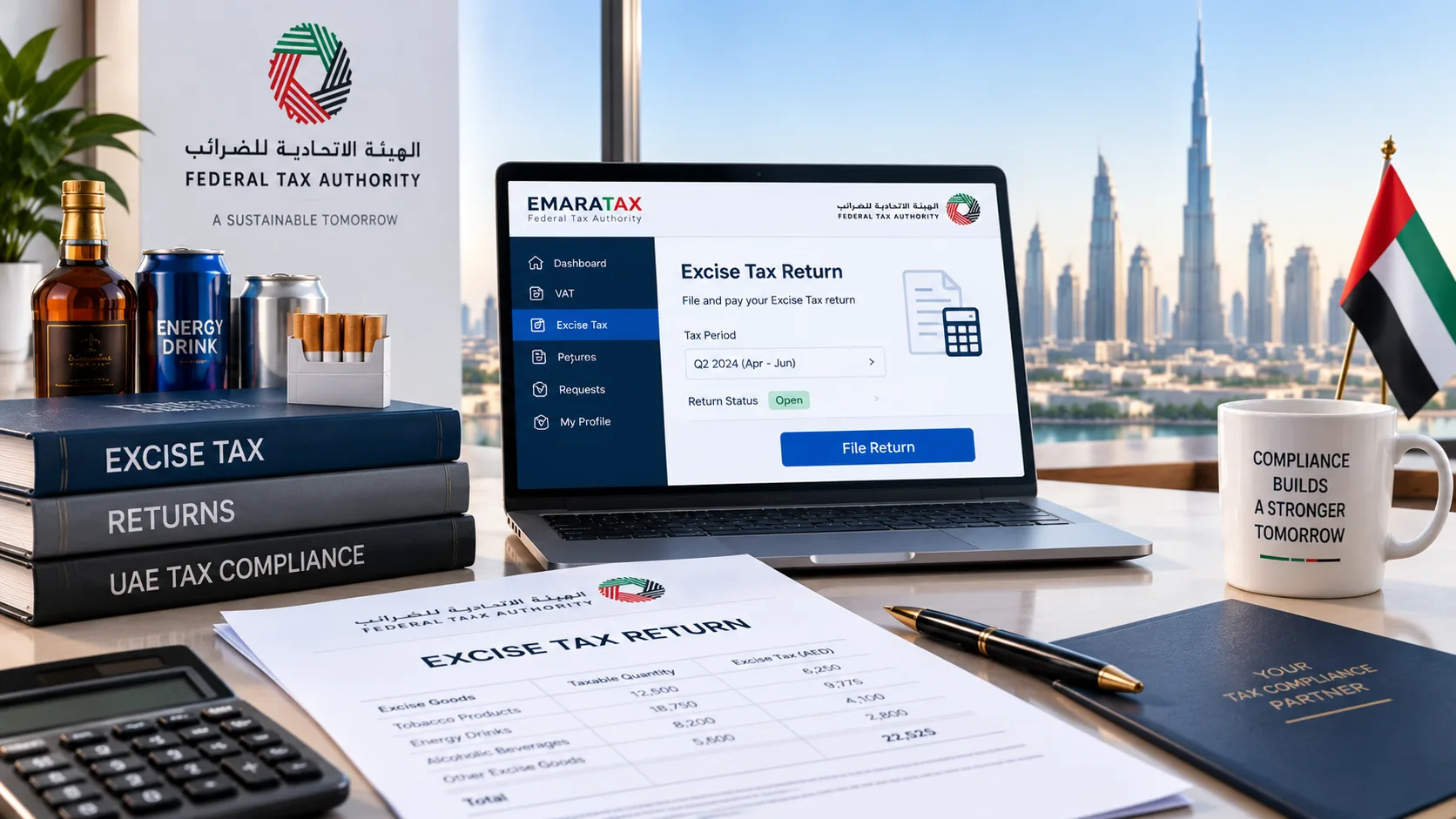
Excise Tax Return Filing Services in Dubai, UAE
What Is an Excise Tax Return?
An Excise Tax return is a periodic declaration submitted to the Federal Tax Authority by a taxable person to report the Excise Tax payable for the relevant tax period.
The return may be populated using information from relevant declarations, including import declarations, production declarations, releases from designated zones, and deductible Excise Tax declarations, where applicable. The taxable person should review the information carefully before submitting the return.
The Federal Tax Authority (FTA) administers UAE federal taxes, including Excise Tax.
If your business needs help with the registration side of Excise Tax, you can also explore our Excise Tax Registration Services in Dubai.
Who Needs to File an Excise Tax Return in the UAE?
Businesses registered for Excise Tax may have periodic return filing obligations depending on their activities and tax registration status.
This can include taxable persons involved in activities such as:
- Importing excisable goods
- Producing or manufacturing excisable goods
- Stockpiling excisable goods in applicable circumstances
- Releasing excisable goods from a designated zone
- Other activities that create Excise Tax reporting obligations
The exact reporting requirements can vary depending on the nature of the business and its transactions.
The FTA’s current guidance confirms that registered taxable persons are required to file Excise Tax returns by the applicable deadline following the end of the tax period.
If you are unsure about your filing obligations, our Excise Tax Compliance Services can help review your position.
Excise Tax Return Filing Period in the UAE
The standard Excise Tax period is one calendar month. In certain circumstances, the FTA may agree to a longer tax period.
The applicable return should be submitted no later than the 15th day of the calendar month following the end of the tax period. The Excise Tax payable is also generally due within the same timeframe.
For example, where the applicable tax period ends on the last day of a month, the return and payment would generally be due by the 15th day of the following month.
Businesses should always verify their specific EmaraTax filing deadline because the applicable requirements can depend on the tax period and the business’s circumstances.
For official guidance, refer to the FTA Excise Tax Filing and Payment Guidance .
How to File an Excise Tax Return in the UAE
Excise Tax returns are submitted electronically through the FTA’s EmaraTax platform.
The general process involves reviewing the relevant declarations, checking the information populated in the return, confirming the Excise Tax liability, submitting the return, and completing the required payment.
Step 1: Review Your Excise Tax Transactions
Before preparing the return, businesses should review all relevant transactions and declarations for the tax period.
This may include:
- Import declarations
- Production declarations
- Releases from designated zones
- Deductible Excise Tax declarations
- Relevant stock movements
- Other applicable Excise Tax transactions
The information from relevant declarations may be used to populate the Excise Tax return.
Step 2: Review the Excise Tax Return
Once the return is available in EmaraTax, the taxable person should carefully review the information shown in the return.
Businesses should check:
- Taxable transactions
- Excise goods
- Quantities and values
- Tax calculations
- Deductible Excise Tax
- Total Excise Tax payable
- Other relevant information
If information appears incorrect, the business should identify the underlying declaration or transaction and take the appropriate corrective action before submitting the return.
Step 3: Verify the Excise Tax Liability
The taxable person should verify the total Excise Tax payable before submitting the return.
FTA guidance explains that the return may be automatically populated using declarations submitted during the tax period. The taxable person remains responsible for reviewing the information and ensuring that the return is accurate.
Our Excise Tax Return Filing Services can help businesses review their return before submission.
Step 4: Submit the Excise Tax Return
After reviewing the information, the taxable person can submit the return through EmaraTax.
The return should be submitted within the applicable deadline to avoid potential compliance issues.
Businesses should retain appropriate records of the submitted return and related declarations for their tax records.
Step 5: Pay the Excise Tax Due
After determining the amount payable, the business should settle the Excise Tax liability within the applicable deadline.
The payment deadline generally follows the same 15th-day deadline applicable to the Excise Tax return.
Businesses should ensure that the payment is completed successfully and retain the relevant payment records.
What Information Is Required for Excise Tax Return Filing?
The information required depends on the business’s activities and the transactions carried out during the tax period.
Depending on the circumstances, businesses may need to review:
- Import declarations
- Production declarations
- Designated zone transactions
- Deductible Excise Tax
- Excise goods information
- Quantity and value information
- Tax calculations
- Supporting accounting records
- Customs documentation
- Previous return information
Maintaining accurate records makes it easier to prepare and review the Excise Tax return.
Excise Tax Returns for Importers
Businesses importing Excise Goods into the UAE may have specific declaration and reporting requirements.
For registered importers, the Excise Tax liability associated with imports is generally accounted for through the normal Excise Tax return process rather than being paid at the point of import.
For certain non-registered importers, Excise Tax may instead be payable through the applicable import declaration process.
The exact treatment depends on the importer’s registration status and the circumstances of the import.
The FTA provides specific guidance for Excise Tax Importers covering the applicable declaration and reporting requirements.
Excise Tax Returns for Manufacturers
Businesses manufacturing excisable goods in the UAE may have production declaration and Excise Tax return obligations.
Relevant production declarations can contribute to the information used to calculate the Excise Tax liability reported in the periodic return.
Manufacturers should therefore ensure that their production records, declarations, inventory information, and Excise Tax calculations are properly maintained.
Our Excise Tax Advisory Services can assist businesses with reviewing their Excise Tax obligations and reporting processes.
Excise Tax Returns for Designated Zones
Businesses involved in the movement or release of excisable goods from designated zones may have additional declaration and reporting requirements.
The applicable treatment depends on the nature of the transaction and whether the relevant goods are released under circumstances that create an Excise Tax liability.
Businesses should maintain proper documentation for transactions involving designated zones and ensure that the relevant declarations are completed correctly.
Excise Tax Return Filing Deadline
The standard Excise Tax return deadline is generally the 15th day of the month following the end of the relevant tax period.
The FTA’s current guidance states that the standard tax period is one calendar month, with the possibility of a longer period being agreed with the FTA in certain circumstances.
If the relevant deadline falls on a weekend or public holiday, the applicable rules may provide for the deadline to move to the next working day. Businesses should verify the exact deadline shown in their EmaraTax account and the latest FTA guidance.
For current announcements and filing deadlines, businesses can check the FTA Excise Tax Announcements.
What Happens If an Excise Tax Return Is Filed Late?
Late filing or late payment can result in administrative consequences under UAE tax legislation.
Because UAE tax penalty rules can change, businesses should not rely on older penalty amounts published in historical articles.
The Federal Tax Authority introduced amendments to certain administrative penalties effective from 14 April 2026, including changes affecting VAT and Excise Tax-related violations.
Businesses that have missed a filing deadline should review their tax position promptly and determine whether any outstanding return, payment, correction, or other compliance action is required.
Our Tax Penalty Assistance Services can help businesses review delayed Excise Tax filings and related compliance matters.
Correcting Errors in an Excise Tax Return
Businesses should carefully verify their Excise Tax return before submission.
If a taxable person discovers an error or omission after filing, the appropriate corrective process may depend on the nature and value of the error.
For certain undercalculations of payable tax, the FTA’s current guidance provides specific rules concerning corrections and voluntary disclosures. For example, where an undercalculation exceeds AED 10,000, a voluntary disclosure is generally required within the applicable period after the error is identified.
Because correction requirements can vary, businesses should obtain professional advice before making amendments.
Excise Tax Return Filing and Payment in EmaraTax
The EmaraTax platform is used by taxpayers to manage their UAE tax services electronically.
For Excise Tax return filing, businesses may need to:
- Log in to EmaraTax.
- Access the relevant Excise Tax registration.
- Review applicable declarations.
- Open the Excise Tax return.
- Review the information populated in the return.
- Verify the Excise Tax liability.
- Submit the return.
- Complete payment of the amount due.
- Retain the relevant submission and payment records.
The official EmaraTax Tax Services Portal can be used to access the applicable FTA services.
Why Choose HayyaTax for Excise Tax Return Filing?
Excise Tax return filing requires careful review of declarations, transactions, tax calculations, and payment obligations.
At HayyaTax, our tax consultants help businesses manage their Excise Tax filing requirements and maintain accurate tax records.
Our Excise Tax Return Filing Services Include:
- Excise Tax return preparation
- Review of Excise Tax declarations
- Import declaration review
- Production declaration review
- Designated zone transaction review
- Deductible Excise Tax review
- Excise Tax liability calculation review
- EmaraTax filing assistance
- Payment assistance
- Tax account review
- Correction and amendment guidance
- FTA clarification support
- Ongoing Excise Tax compliance assistance
You can also explore our Excise Tax Services in Dubai for additional support.
Benefits of Professional Excise Tax Return Filing Services
Accurate Return Preparation
Our team reviews the relevant information before submission to help reduce errors and inconsistencies.
Timely Filing
We help businesses monitor their applicable filing deadlines and prepare the required information in advance.
Better Compliance
Professional assistance can help businesses maintain appropriate Excise Tax records and meet their reporting obligations.
Reduced Administrative Burden
Instead of managing the entire process internally, businesses can rely on experienced tax professionals to assist with their Excise Tax filing requirements.
Support With Complex Transactions
Businesses involved in imports, manufacturing, designated zones, or deductible Excise Tax may benefit from professional review of their transactions and declarations.
Who Can Benefit From Our Excise Tax Return Filing Services?
Our service is suitable for businesses that:
- Import excisable goods
- Manufacture excisable goods
- Stockpile excisable goods
- Deal with designated zone transactions
- Have an active Excise Tax registration
- Need assistance with EmaraTax filing
- Have outstanding Excise Tax returns
- Need help reviewing Excise Tax calculations
- Need assistance correcting a previous return
- Want ongoing Excise Tax compliance support
Whether your business is based in Dubai or another emirate, our UAE Tax Consultancy Services can provide support based on your business activities.
Frequently Asked Questions About Excise Tax Return Filing
What is Excise Tax return filing?
Excise Tax return filing is the process of reporting the Excise Tax liability for a relevant tax period to the Federal Tax Authority through the approved electronic tax system.
How often do I need to file an Excise Tax return?
The standard Excise Tax period is generally one calendar month. In certain circumstances, the FTA may agree to a longer tax period.
What is the deadline for filing an Excise Tax return?
The standard deadline is generally the 15th day of the month following the end of the relevant tax period.
Can I file an Excise Tax return through EmaraTax?
Yes. Excise Tax returns are submitted electronically through the FTA’s tax system.
What happens if I miss my Excise Tax return deadline?
Late filing or payment can result in administrative consequences. The applicable treatment should be checked against the current UAE tax legislation and FTA guidance.
Can HayyaTax file my Excise Tax return?
Yes. HayyaTax provides professional Excise Tax Return Filing Services in Dubai [I] and across the UAE.
Can you help with an incorrect Excise Tax return?
Yes. Our tax consultants can review the circumstances and advise on the appropriate correction or disclosure process.
Do non-registered importers need to file Excise Tax returns?
The treatment can differ depending on the importer’s circumstances and registration status. Certain non-registered importers may have Excise Tax obligations through the import declaration process rather than the normal periodic return process.
Can you help with Excise Tax registration as well?
Yes. Businesses that need to register can use our Excise Tax Registration Services.
Get Professional Excise Tax Return Filing Services in Dubai
Managing Excise Tax returns requires accurate records, proper declarations, timely filing, and payment of the tax due.
HayyaTax provides professional Excise Tax Return Filing Services in Dubai for businesses across the UAE. Our tax consultants can assist with return preparation, declaration review, EmaraTax submission, payment requirements, corrections, and ongoing Excise Tax compliance.
If you are looking for reliable support with your UAE Excise Tax obligations, speak to our experienced tax consultants today.
"Excise Tax Return Filing, Made Simple and Stress-Free!"
Our team is ready to simplify the complexities for your UAE business.
Frequently Asked Questions on Excise Tax Return Filing in UAE
Excise tax is an indirect tax imposed on specific goods that are harmful to health or the environment. Businesses that import, produce, or store excise goods in the UAE must register for excise tax and file periodic returns with the Federal Tax Authority (FTA).
The UAE applies excise tax to the following products:
Tobacco and tobacco-related products (100% tax)
Carbonated drinks (50% tax)
Energy drinks (100% tax)
Sweetened drinks (50% tax)
Electronic smoking devices and liquids (100% tax)
Excise tax returns must be filed monthly via the Federal Tax Authority (FTA) e-Services portal. The return should be submitted, and the tax due should be paid within 15 days after the end of each tax period.
To file an excise tax return, follow these steps:
Log in to the FTA’s e-Services portal.
Navigate to the "Excise Tax" section.
Fill in the required details regarding imports, production, or stockpiled goods.
Calculate the total excise tax due.
Submit the return and make the payment before the deadline.
The UAE imposes penalties for non-compliance, including:
AED 1,000 for the first offense and AED 2,000 for repeated offenses within 24 months.
A daily penalty of 2% of the unpaid tax (if not paid on time).
Additional fines for incorrect filing or underreporting of tax due.
Generally, excise tax is non-refundable since it is included in the price of goods. However, businesses can claim a refund if:
Excise goods are exported outside the UAE.
Excise goods are destroyed due to damage or expiry (subject to FTA approval).
Yes, free zone companies dealing with excise goods must file excise tax returns if they:
Import, produce, or store excise goods.
Supply excise goods within the UAE market.
Hold excise goods in a designated zone but later release them into the local market.
Request Free Consultation
Fill in the form below, and we’ll get back to you within 24 hours.