
A real-world guide to obtaining UAE Tax Residency Certificate, avoiding double taxation, and the paperwork maze.
Emma had built a good life in Dubai. But when a letter arrived from HMRC back in the UK, her otherwise smooth professional life suddenly hit a wall — a wall called double taxation.
Emma’s Story: When Tax Paperwork Gets Complicated
Emma is a British professional who relocated to Dubai several years ago. She had settled in well — great job, stable income, and the lifestyle that makes the UAE so attractive to expats from all over the world. What she hadn’t anticipated was receiving an official request from the UK’s tax authority asking her to prove where she was actually tax-resident.
The reason? Under international tax rules, individuals can sometimes be considered taxable in more than one country simultaneously. Without proof of her UAE tax residency, Emma could face being taxed twice on the same income — once in the UAE and once in the UK under British tax law.
The document she needed was a Tax Residency Certificate — officially issued by the UAE’s Federal Tax Authority (FTA). On paper, it sounded simple. In reality, it was anything but.
“I spent hours on government portals trying to understand what documents I needed, whether I even qualified, and how to submit everything correctly. The deadlines from HMRC were approaching and I felt completely stuck. I didn’t know where to begin.”
What Is a Tax Residency Certificate (TRC)?
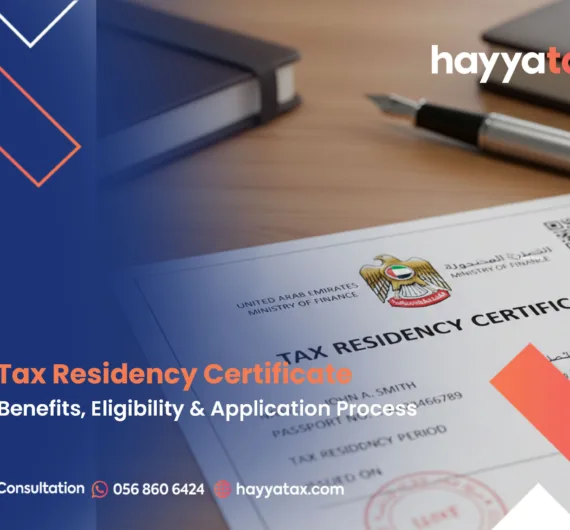
A Tax Residency Certificate — sometimes called a Tax Domicile Certificate — is an official document issued by the UAE Federal Tax Authority confirming that an individual or company is a tax resident in the United Arab Emirates.
It is primarily used to claim benefits under the UAE’s extensive network of Double Taxation Avoidance Agreements (DTAAs) — treaties the UAE has signed with over 130 countries, including the United Kingdom, to ensure individuals and businesses are not taxed twice on the same income.
Without a TRC, expats like Emma may be legally required to pay income tax in their home country, even if they live and work full-time abroad. With a valid TRC, that obligation is typically eliminated or significantly reduced — depending on the treaty in place.
Who Is Eligible for a UAE Tax Residency Certificate?
Eligibility for a UAE Tax Residency Certificate depends on whether you are applying as an individual or a company.
For individuals, you will generally need:
- A minimum of 180 days of UAE residence in the relevant year
- Valid UAE residency visa and Emirates ID
- Proof of physical presence (travel history from GDRFA)
- Proof of UAE address (tenancy contract or utility bill)
- Recent UAE bank statement showing local financial activity
- Employment contract or proof of business activity
- Passport copy
For companies, the requirements typically include:
- Valid UAE trade license (minimum 1 year active)
- Memorandum of Association (MOA)
- Company bank statements (minimum 6 months)
- Audited financial statements
- Passports and visas of shareholders and directors
Emma, who had lived and worked in Dubai for several years, met the residency threshold comfortably. But gathering the right documents in the right format, submitting them through the FTA’s online portal, and ensuring everything was accurate — that is where things became overwhelming.
The Application Process: Step by Step
Applications are submitted through the UAE Federal Tax Authority’s EmaraTax portal. Here is how the process works:
- Register on EmaraTax — Set up or link your FTA account via the EmaraTax portal.
- Prepare your documents — Gather all required documents in the correct format.
- Submit your application — Complete the online form and upload your supporting documents.
- Pay the government fee — Currently AED 50 application fee plus AED 500 for the certificate itself (for individuals).
- FTA review — The authority reviews your application and may request additional information.
- Certificate issued — Upon approval, the TRC is issued digitally through the portal.
The entire process can take anywhere from 5 to 15 working days, depending on document completeness and FTA workload. Any errors or missing information can result in rejection — forcing the process to start over entirely.
This is precisely where Emma found herself going in circles. One document was in the wrong format. Another needed translation. Her travel history printout wasn’t accepted. And the EmaraTax portal itself presented its own set of confusions.
How HayyaTax Stepped In
When Emma reached out to HayyaTax, the process changed immediately. Rather than facing the FTA portal alone, she had an experienced team working alongside her — one that had handled dozens of TRC applications across different nationalities and circumstances.
Her eligibility was confirmed in the first consultation. The HayyaTax team reviewed her situation and confirmed she met all the requirements — giving her the clarity she had been missing for weeks.
A precise document checklist was provided, with gaps identified before submission rather than after rejection. The application was then submitted correctly the first time, with every field accurate and every supporting document meeting FTA requirements.
When the FTA requested a minor clarification, HayyaTax handled the correspondence directly — no delays, no confusion for Emma.
Her Tax Residency Certificate was approved and issued. She submitted it to HMRC. The double taxation issue was resolved. And she moved on with her career — without the financial and administrative burden that had been hanging over her.
Common Mistakes That Delay TRC Applications
Having helped many expats and businesses through the process, HayyaTax regularly sees the same errors derail applications:
- Insufficient days of presence — not meeting the 180-day threshold for the relevant tax year
- Expired or inconsistent documents — submitting documents that don’t match each other or are past their validity date
- Weak UAE financial activity — bank statements showing minimal local transactions raise flags with the FTA
- Applying for the wrong year — the TRC must correspond to the specific tax year being disputed
- Portal errors — incorrect entries on the EmaraTax form that lead to automatic rejection
Getting these details right from the start is the difference between a smooth approval and weeks of delays.
Final Thoughts: Don’t Navigate This Alone
The UAE’s Tax Residency Certificate is a genuinely powerful document. For expats from countries like the UK, Australia, France, India, and many others, it can mean the difference between being taxed twice on your income — or not at all. That is not a bureaucratic technicality. That is real money, and real peace of mind.
But the application process demands precision. One wrong document, one missed requirement, one portal error — and weeks of effort can be lost.
Emma’s story is not unusual. What made the difference was having the right team handle it.
If you have received a request from your home country’s tax authority, or you simply want to get ahead of the issue before it becomes urgent, now is the time to act.
Need a Tax Residency Certificate? Let HayyaTax handle it — from eligibility check to FTA approval. Contact us today.
HayyaTax is a UAE-based tax consultancy specialising in Tax Residency Certificates, corporate tax, VAT, and expat tax advisory services.