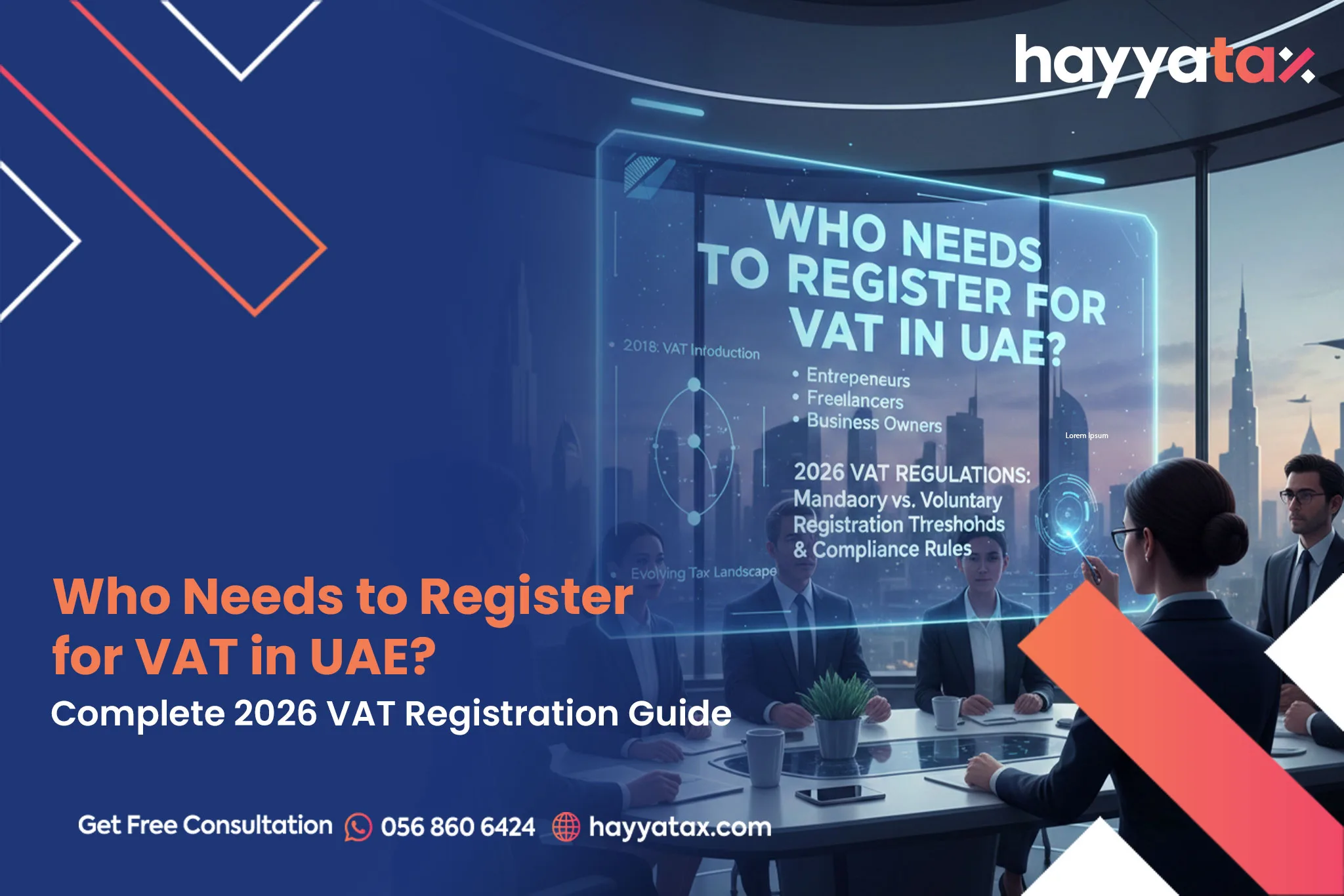
Who Needs to Register for VAT in UAE is one of the most important questions for entrepreneurs, freelancers, and business owners operating in the UAE in 2026. With evolving tax regulations and strict compliance requirements, understanding VAT registration rules is essential for avoiding penalties and managing business finances efficiently.
Since VAT’s introduction in 2018, regulations have evolved significantly. To avoid penalties and cash flow disruptions, businesses must clearly understand whether they fall under mandatory or voluntary registration — and, once registered, what the process actually involves.
VAT Registration Thresholds
The Federal Tax Authority (FTA) has defined two main VAT registration thresholds, based on taxable supplies and imports covering both standard-rated (5%) and zero-rated (0%) supplies:
Mandatory VAT Registration — AED 375,000
You must register if your taxable supplies and imports exceeded AED 375,000 in the last 12 months, or you expect them to exceed that within the next 30 days. Registration becomes compulsory once either condition is met.
Voluntary VAT Registration — AED 187,500
You may register voluntarily if your taxable supplies, imports, or expenses exceeded AED 187,500 in the past 12 months, or you expect to exceed that within 30 days.
Start-ups with high initial expenses (rent, equipment, licensing) can benefit from voluntary registration by reclaiming VAT and improving early cash flow.
VAT-Exempt Categories
While most goods and services are subject to the 5% rate, certain essential categories remain exempt, including basic food items, healthcare services, and educational services.
Who This Applies To
Mainland Businesses
VAT rules apply uniformly across the UAE — physical location doesn’t affect registration, only turnover. The following must register once the threshold is reached: Limited Liability Companies (LLCs), Public Joint Stock Companies, Partnerships and Joint Ventures, and Sole Establishments. If one individual owns multiple sole establishments, their combined turnover is what counts toward the threshold.
Foreign and Non-Resident Businesses
Non-resident entities supplying goods or services in the UAE must register from their first taxable supply — there is no minimum threshold — unless the Reverse Charge Mechanism applies and the UAE customer accounts for VAT instead.
Free Zone Companies
A common misconception is that Free Zone companies are exempt from VAT. This is incorrect:
– Designated Zones (e.g., JAFZA, KIZAD, DAFZA) — movement of goods within or between designated zones may be outside VAT scope, but services and mainland supplies are taxable. Registration is mandatory once turnover exceeds AED 375,000.
– Non-Designated Free Zones — treated like mainland entities; standard VAT applies.
Freelancers and Individuals
From 2026 onwards, increased attention is given to individuals conducting business activities:
– Freelancers and consultants earning more than AED 375,000 annually from services must register and obtain a Tax Registration Number (TRN)
– Property owners — residential leasing is generally VAT-exempt; commercial leasing (shops, offices, warehouses) is taxable, and registration is required once taxable rental income exceeds AED 375,000
– Content creators and digital professionals — income from sponsorships, advertising, and digital services is taxable once thresholds are met
Documents Required for Registration
To register for VAT, prepare:
Business documentation — trade license copy, certificate of incorporation, articles of association, description of business activities
Financial information — turnover details for the previous 12 months (in AED) with supporting documentation, projected turnover for the next 30 days, estimated import/export values with each GCC country, declaration of potential GCC supplier or customer relationships
Personal documentation — ID documents for authorized signatories (passport and Emirates ID), power of attorney documentation, bank account details, customs registration documentation (if applicable)
Step-by-Step Registration Process
- Create an account on the FTA’s e-services portal
- Access the VAT registration form after logging in
- Provide company information — business details, personal information, contact details, and banking information
- Specify VAT details — relevant information about your registration status and any pertinent business relationships
- Review and submit — carefully verify all entered information before finalizing
Tax Group Registration
Businesses looking to register as a tax group should know:
- Only the designated representative company can apply for tax group registration
- The representative must either hold a TRN already, or submit a VAT registration application simultaneously with the tax group formation request
- Each potential group member must qualify as a legal entity under UAE law, maintain UAE residency status, and not belong to any other existing tax group
Late Registration Penalties
Once you exceed the mandatory threshold, you have 30 days to apply for registration.
| Violation | Penalty (2026) |
|---|---|
| Late registration | AED 10,000 |
| Late VAT payment | 14% annual interest (monthly) |
| Late return filing | AED 1,000 (first time), AED 2,000 (repeat) |
Late registration may also lead to backdated VAT liabilities.
VAT Deregistration
Circumstances that may call for deregistration: your company stops making taxable supplies, your taxable supplies fall below the voluntary threshold, or you don’t anticipate exceeding the voluntary threshold within the next 30 days.
Important: voluntarily registered companies must maintain registration for at least 12 months before applying to deregister. Even after deregistration, businesses must retain tax records and comply with post-deregistration audit requirements set by the FTA.
How HayyaTax Can Help
- Threshold assessment — evaluating historical turnover and projected revenue to determine your exact registration date
- VAT registration assistance — complete support with FTA portal registration, document submission, and TRN issuance
- Voluntary registration strategy — helping start-ups and growing businesses optimize VAT recovery during early stages
- VAT grouping advisory — structuring VAT Groups for multi-entity businesses to streamline reporting
- Ongoing compliance — VAT return filing, record maintenance, audit support, regulatory updates
Frequently Asked Questions
What are the VAT thresholds for 2026?
Mandatory: AED 375,000 taxable turnover. Voluntary: AED 187,500 taxable turnover or expenses.
Do freelancers need VAT registration?
Yes — freelancers, consultants, and self-employed professionals must register once annual taxable income exceeds AED 375,000. A trade license isn’t required for VAT liability to apply; any qualifying “business activity” can trigger registration.
What’s the rule for foreign businesses?
Non-resident businesses must register from their first taxable supply, unless the Reverse Charge Mechanism applies. There’s no minimum threshold for non-residents.
How long do I have to register after crossing the threshold?
30 days from exceeding AED 375,000. Missing this window results in a AED 10,000 penalty and possible backdated VAT.
Are Free Zone companies exempt?
No. Free Zone companies must register once taxable turnover exceeds AED 375,000.
Can I deregister at any time?
Only if you meet the qualifying circumstances — and if you registered voluntarily, you must maintain registration for at least 12 months first.
Conclusion
If you’re unsure whether — or when — your business needs to register for VAT in the UAE, professional guidance helps you avoid penalties and maintain long-term compliance. Whether you’re a start-up, freelancer, or established enterprise, understanding these thresholds, documentation requirements, and deadlines is the foundation of staying compliant.