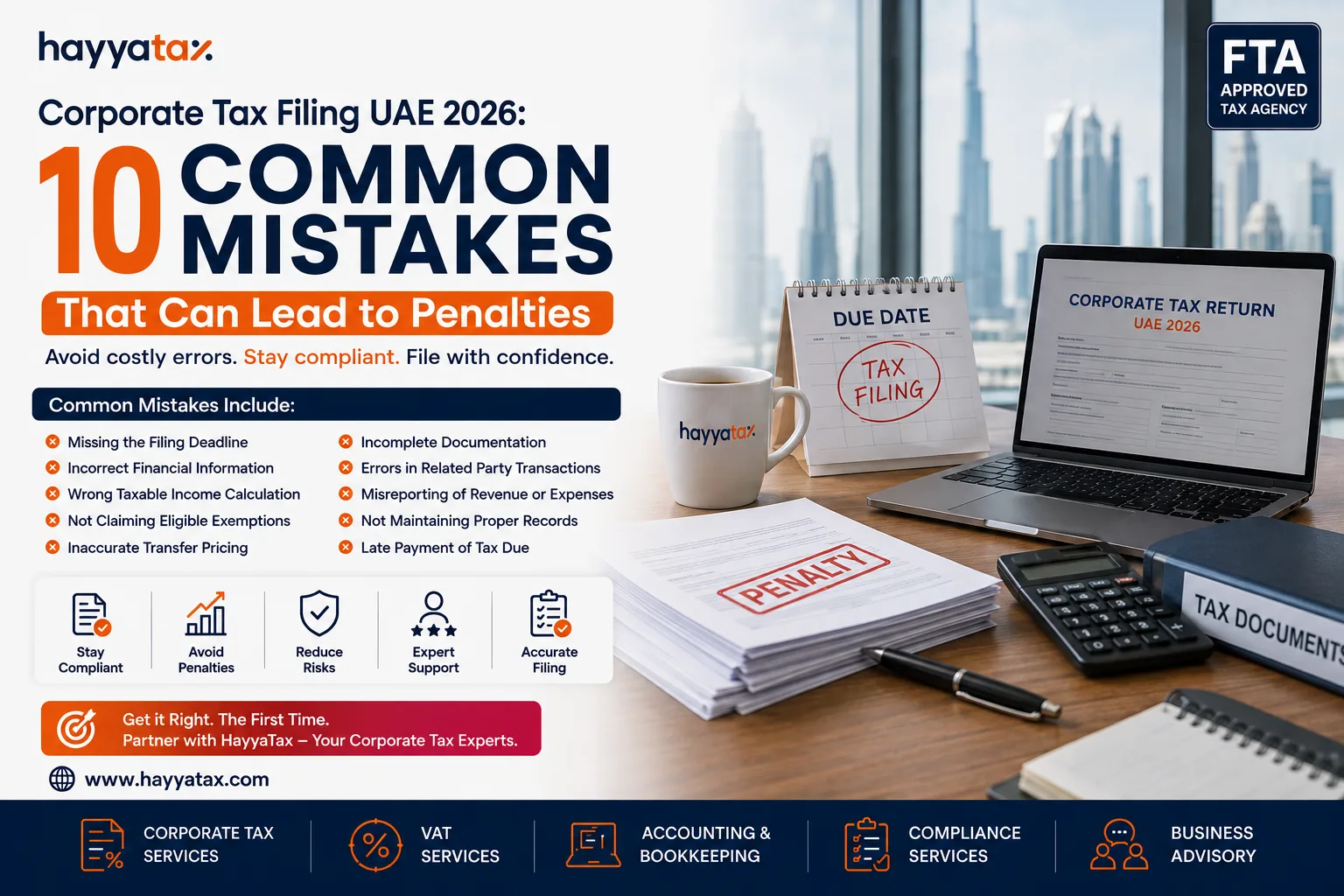
Corporate Tax Filing UAE: 10 Common Mistakes That Can Lead to Penalties
Corporate Tax Filing UAE is one of the most important compliance obligations for businesses operating in the United Arab Emirates. Filing an accurate Corporate Tax Return within the prescribed deadline helps businesses comply with Federal Tax Authority (FTA) regulations and reduces the risk of unnecessary penalties.
However, many businesses make avoidable mistakes during the filing process. These errors can result in delayed filings, incorrect tax calculations, additional tax liabilities, and penalties. Understanding these common mistakes can help businesses remain compliant and avoid costly consequences.
This guide explains the 10 most common Corporate Tax Filing UAE mistakes and provides practical tips to help your business stay compliant.
Why Accurate Corporate Tax Filing Matters
Corporate Tax compliance is more than simply submitting a tax return. Businesses must maintain proper accounting records, calculate taxable income correctly, retain supporting documentation, and comply with the UAE Corporate Tax Law.
Professional Corporate Tax Filing UAE services help businesses:
- Prepare accurate tax returns
- Calculate taxable income correctly
- Maintain supporting documentation
- Reduce compliance risks
- Avoid unnecessary penalties
- Meet FTA filing requirements
1. Missing the Corporate Tax Filing Deadline
One of the most common mistakes is submitting the Corporate Tax Return after the applicable filing deadline.
Late filing can expose businesses to administrative penalties and additional compliance issues.
How to avoid it
- Track important filing deadlines.
- Maintain updated accounting records throughout the year.
- Prepare your Corporate Tax Return well before the due date.
2. Incorrect Taxable Income Calculation
Many businesses calculate taxable income incorrectly by relying solely on accounting profits without making the adjustments required under UAE Corporate Tax rules.
Common errors include:
- Incorrect expense treatment
- Missing allowable adjustments
- Ignoring exempt income
- Miscalculating taxable profits
Professional review helps ensure accurate tax computation.
3. Poor Bookkeeping and Accounting Records
Incomplete bookkeeping is one of the biggest reasons businesses struggle during Corporate Tax Filing UAE.
Missing financial records make it difficult to:
- Calculate taxable income
- Support deductions
- Reconcile financial statements
- Respond to FTA information requests
Maintaining accurate accounting records throughout the year simplifies tax compliance.
4. Failing to Maintain Supporting Documents
Businesses should retain supporting documentation for financial transactions and tax calculations.
Examples include:
- Sales invoices
- Purchase invoices
- Bank statements
- Expense receipts
- Payroll records
- Contracts
- Financial statements
Well-organized documentation helps support the figures reported in the Corporate Tax Return.
5. Ignoring Related-Party Transactions
Transactions between related parties may require additional analysis under UAE Transfer Pricing rules.
Common examples include:
- Management fees
- Intercompany loans
- Shared services
- Royalty payments
- Cost allocations
Where applicable, businesses should ensure these transactions comply with the arm’s length principle and maintain the required documentation.
6. Claiming Non-Deductible Expenses
Not every business expense is deductible for Corporate Tax purposes.
Claiming expenses that are not deductible may increase the risk of adjustments during an FTA review.
Businesses should carefully review expenses before preparing their Corporate Tax Return.
7. Failing to Reconcile Financial Statements
Differences between accounting records, bank statements, VAT records, and financial statements can create inconsistencies.
Before filing, businesses should reconcile:
- Bank accounts
- Sales
- Purchases
- VAT records
- Payroll
- Fixed assets
Accurate reconciliation improves the reliability of the tax return.
8. Relying on Manual Calculations
Manual spreadsheets increase the risk of calculation errors.
Professional accounting systems help businesses:
- Improve accuracy
- Reduce human error
- Maintain complete audit trails
- Generate reliable financial reports
9. Waiting Until the Last Minute
Many businesses start preparing for Corporate Tax Filing only a few days before the deadline.
Last-minute preparation often leads to:
- Missing documents
- Calculation mistakes
- Filing delays
- Increased stress
Preparing throughout the financial year makes the filing process much easier.
10. Filing Without Professional Review
Corporate Tax legislation continues to evolve.
Submitting a Corporate Tax Return without professional review may result in:
- Incorrect tax calculations
- Missed adjustments
- Documentation gaps
- Compliance risks
Working with experienced Corporate Tax professionals provides greater confidence that the return has been prepared accurately.
Best Practices for Successful Corporate Tax Filing UAE
To improve compliance, businesses should:
- Maintain accurate bookkeeping
- Prepare financial statements regularly
- Reconcile accounts monthly
- Keep supporting documents organized
- Review related-party transactions
- Monitor filing deadlines
- Seek professional tax advice when required
Documents Required for Corporate Tax Filing
Businesses should generally maintain:
- Financial Statements
- Trial Balance
- General Ledger
- Bank Statements
- Sales Invoices
- Purchase Invoices
- Expense Records
- Payroll Records
- Fixed Asset Register
- VAT Records
- Related-Party Agreements
- Supporting Financial Documents
How HayyaTax Can Help
HayyaTax offers comprehensive Corporate Tax Filing UAE services to help businesses remain compliant with UAE tax regulations.
Our services include:
- Corporate Tax Registration
- Corporate Tax Return Filing
- Tax Computation
- Accounting & Bookkeeping
- Financial Statement Review
- Transfer Pricing Support
- Tax Advisory
- FTA Compliance Support
- Audit Assistance
- Ongoing Tax Consultation
Our experienced professionals help businesses minimize compliance risks and file Corporate Tax Returns accurately and on time.
Frequently Asked Questions
What is Corporate Tax Filing UAE?
Corporate Tax Filing UAE is the process of preparing and submitting a Corporate Tax Return to the Federal Tax Authority (FTA) based on a business’s taxable income.
Can mistakes in Corporate Tax Filing lead to penalties?
Yes. Missing deadlines, maintaining inaccurate records, incorrect tax calculations, or failing to comply with filing requirements can result in administrative penalties or additional tax assessments where applicable.
Why is bookkeeping important for Corporate Tax Filing?
Accurate bookkeeping supports reliable financial statements, proper tax calculations, and compliance with UAE Corporate Tax requirements.
Should businesses seek professional assistance?
Professional Corporate Tax advisors can help businesses prepare accurate tax returns, review calculations, maintain documentation, and improve overall compliance.
Conclusion
Corporate Tax Filing UAE requires careful planning, accurate financial records, and timely compliance. Avoiding common mistakes such as late filing, poor bookkeeping, incorrect tax calculations, and inadequate documentation can significantly reduce compliance risks and help businesses meet their obligations confidently.
If your business requires expert support with Corporate Tax compliance, HayyaTax provides professional filing, accounting, tax advisory, and compliance services tailored to businesses across the UAE.