UAE Small Business Relief Extended to 2029: What SMEs Need to Know
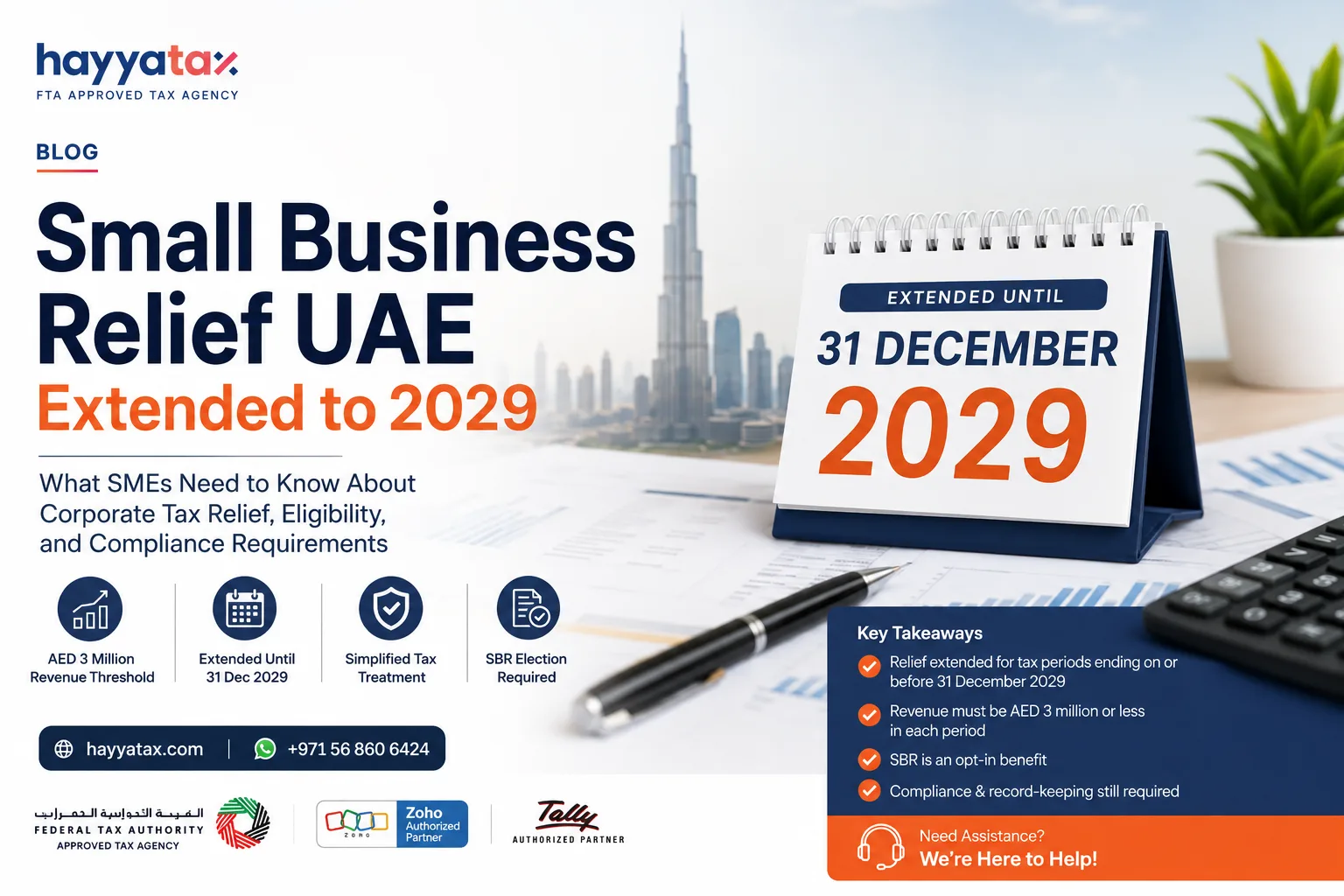
Small Business Relief UAE has been extended to 31 December 2029, giving eligible small businesses and start-ups additional time to benefit from simplified Corporate Tax treatment.
Small Business Relief UAE is designed to support eligible small businesses and start-ups by reducing their Corporate Tax burden. Eligible businesses can elect for the relief when filing their Corporate Tax Return, subject to the applicable conditions and requirements.
For many UAE business owners, the future of Small Business Relief was an important concern as the original relief period was scheduled to end in 2026. The extension provides greater certainty for eligible SMEs while maintaining the existing AED 3 million revenue threshold and other eligibility conditions.
However, Small Business Relief should not be misunderstood as a complete exemption from Corporate Tax compliance. Businesses must still meet the relevant registration, filing, record-keeping and other regulatory requirements.
What Is Small Business Relief UAE?
Small Business Relief is a provision under the UAE Corporate Tax Law designed to support eligible small businesses and start-ups by reducing their Corporate Tax burden and compliance requirements.
Under the relief, an eligible UAE Resident Person can elect to be treated as having no Taxable Income for the relevant Tax Period.
The key threshold remains:
AED 3 million or less in Revenue for the relevant Tax Period and all previous Tax Periods, subject to the applicable rules and conditions.
The relief is not an automatic benefit. An eligible taxpayer must make an election when submitting its Corporate Tax Return.
The Federal Tax Authority confirms that Small Business Relief is available to eligible Resident Persons, while Qualifying Free Zone Persons and members of certain multinational enterprise groups are excluded.
Small Business Relief Extended Until 2029
The original Small Business Relief framework under Ministerial Decision No. 73 of 2023 applied the AED 3 million revenue threshold to qualifying tax periods ending on or before 31 December 2026.
With the extension to 2029, eligible businesses can potentially continue using the relief for qualifying tax periods ending on or before:
31 December 2029
This provides additional planning certainty for SMEs, entrepreneurs and start-ups operating in the UAE.
Importantly, the extension does not mean that the AED 3 million threshold has increased. Businesses must continue monitoring their revenue carefully.
Key Dates for UAE Small Business Relief
| Date | Significance |
|---|---|
| 1 June 2023 | Small Business Relief became applicable for qualifying tax periods. |
| 31 December 2026 | Original end date under the initial framework. |
| 31 December 2029 | Extended end date for eligible tax periods under the updated rules. |
| 30 September 2026 | Corporate Tax Return deadline for businesses with a 31 December 2025 tax-period end, subject to the applicable filing rules. |
Businesses should remember that the SBR end date is not the same as their Corporate Tax filing deadline. Filing deadlines are determined based on the taxpayer’s specific Tax Period.
Who Can Claim Small Business Relief?
Generally, Small Business Relief may be available to a UAE Resident Person that satisfies the relevant conditions.
The most important eligibility requirements include:
- Revenue must be AED 3 million or less for the relevant Tax Period.
- The revenue condition must also be satisfied for the applicable previous Tax Periods.
- The taxpayer must make an election for Small Business Relief.
- The taxpayer must not be a Qualifying Free Zone Person.
- The taxpayer must not be a member of an excluded multinational enterprise group meeting the applicable conditions.
The FTA explains that the AED 3 million threshold is tested for both the current and previous Tax Periods. Exceeding the threshold in a relevant period can prevent the taxpayer from using SBR in subsequent periods under the applicable rules.
Is Small Business Relief Automatic?
No.
This is one of the most important points for UAE SME owners.
Simply having revenue below AED 3 million does not automatically mean that Small Business Relief has been applied.
The eligible taxpayer must elect for SBR when filing its Corporate Tax Return through EmaraTax.
Businesses should therefore review their eligibility before filing and ensure that the appropriate election is made.
What Does Small Business Relief Actually Do?
When a valid SBR election is made and all conditions are satisfied, the taxpayer is treated as having not derived Taxable Income for that Tax Period.
This can significantly reduce the Corporate Tax liability for an eligible business.
However, SBR should not be confused with the UAE’s standard 0% Corporate Tax rate on Taxable Income up to AED 375,000.
They are different mechanisms.
Under SBR, the eligible taxpayer is treated as having no Taxable Income for the relevant period, subject to the rules governing the relief.
Small Business Relief Is Not a Compliance Holiday
One of the biggest misconceptions among SME owners is that SBR eliminates their tax compliance responsibilities.
It does not.
An eligible business may still need to:
- Register for Corporate Tax where required.
- File its Corporate Tax Return within the applicable deadline.
- Maintain proper accounting and financial records.
- Maintain evidence supporting its revenue figures.
- Monitor eligibility for every relevant Tax Period.
- Maintain appropriate supporting documentation for its tax position.
- Comply with other applicable UAE tax and regulatory requirements.
The FTA confirms that taxable persons are required to register for Corporate Tax, and late registration can result in an AED 10,000 administrative penalty, subject to applicable waiver initiatives and conditions.
What About Transfer Pricing?
This area requires particular attention.
A common misconception is that Small Business Relief completely removes transfer pricing requirements.
The FTA’s Small Business Relief guidance states that a taxpayer electing for SBR is not required to comply with transfer pricing documentation requirements for that period. However, the taxpayer must still comply with the arm’s-length principle where applicable.
Therefore, businesses should continue to properly identify and review transactions with related parties and connected persons.
SBR should not be treated as permission to conduct related-party transactions without appropriate commercial and tax consideration.
What Happens If Revenue Exceeds AED 3 Million?
The AED 3 million threshold is based on Revenue, not profit.
For example:
Business A
- Revenue: AED 2.8 million
- Expenses: AED 2.2 million
- Profit: AED 600,000
The business may potentially qualify for SBR, assuming all other conditions are satisfied.
Business B
- Revenue: AED 3.2 million
- Expenses: AED 2.9 million
- Profit: AED 300,000
The business would not satisfy the AED 3 million revenue threshold for that relevant period.
This is why SMEs should monitor revenue, rather than looking only at their net profit.
The FTA also makes clear that once the revenue threshold is exceeded in a relevant Tax Period, the taxpayer may no longer be eligible for SBR under the applicable rules.
Can Businesses Split Their Activities to Stay Below AED 3 Million?
Businesses should be extremely careful about artificially separating business activities to remain below the threshold.
The original Small Business Relief framework specifically addresses artificial separation of businesses. Where the FTA determines that businesses or business activities have been artificially separated to obtain a Corporate Tax advantage, the general anti-abuse rules may apply.
Therefore, business restructuring should always have genuine commercial reasons and should be reviewed carefully from a UAE Corporate Tax perspective.
Free Zone Companies and Small Business Relief
Being located in a UAE Free Zone does not automatically mean that a business can claim Small Business Relief.
A Qualifying Free Zone Person is specifically excluded from SBR.
Therefore, Free Zone businesses should first determine their Corporate Tax status and whether they are seeking to apply the Qualifying Free Zone Person regime before considering SBR.
This is particularly important because choosing the wrong tax treatment can have significant consequences for Corporate Tax compliance.
What SMEs Should Do Now
With the extension providing additional time, UAE SMEs should use the opportunity to strengthen their tax and accounting processes.
1. Monitor Revenue Every Tax Period
Do not wait until the Corporate Tax filing deadline.
Maintain regular revenue tracking so that management can identify whether the business is approaching the AED 3 million threshold.
2. Review Previous Tax Periods
SBR eligibility is not based only on the current year’s revenue. Previous relevant Tax Periods also need to be considered.
3. Make the SBR Election Correctly
SBR is an election-based relief. Eligible taxpayers need to make the election through their Corporate Tax Return.
4. Maintain Proper Accounting Records
Even if the business expects to pay no Corporate Tax because of SBR, accurate books and supporting documents remain important.
5. Review Related-Party Transactions
Businesses with related-party or connected-person transactions should review their arrangements and ensure they comply with the applicable UAE Corporate Tax rules, including the arm’s-length principle.
6. Check Your Free Zone Status
If the business operates from a Free Zone, determine whether it is a Qualifying Free Zone Person before deciding whether SBR is available.
7. Don’t Confuse SBR With Your Filing Deadline
The extension to 2029 does not extend individual Corporate Tax filing deadlines.
Each business should determine its own filing deadline based on its Tax Period.
Example: How Small Business Relief Can Help
Consider a UAE Resident company with the following results:
Revenue: AED 2.5 million
Expenses: AED 1.8 million
Accounting profit: AED 700,000
If the company satisfies all SBR conditions and validly elects for the relief, it can be treated as having no Taxable Income for the relevant Tax Period.
Without SBR, the company’s Corporate Tax position would instead need to be determined under the normal Corporate Tax rules.
This illustrates why eligible SMEs should assess SBR before completing their Corporate Tax Return.
Frequently Asked Questions
1. What is the UAE Small Business Relief?
Small Business Relief is a Corporate Tax relief that allows an eligible UAE Resident Person to elect to be treated as having no Taxable Income for a qualifying Tax Period, subject to the applicable conditions.
2. What is the SBR revenue threshold?
The threshold remains AED 3 million for the relevant Tax Period and applicable previous Tax Periods.
3. Has the AED 3 million threshold increased?
No. The extension changes the period during which the relief is available; it does not increase the AED 3 million revenue threshold.
4. Is Small Business Relief automatic?
No. Eligible taxpayers must elect for the relief when filing their Corporate Tax Return.
5. Can a Qualifying Free Zone Person claim SBR?
No. Qualifying Free Zone Persons are excluded from Small Business Relief.
6. Does SBR eliminate Corporate Tax registration?
No. Businesses that are required to register for Corporate Tax must comply with the applicable registration requirements even if they may subsequently elect for SBR.
7. Does SBR eliminate transfer pricing requirements?
SBR can remove the transfer pricing documentation requirement for the relevant period, but the arm’s-length principle still applies where relevant.
8. What happens if my revenue exceeds AED 3 million?
The business will generally lose eligibility for SBR under the applicable rules. Businesses should therefore monitor revenue carefully throughout the year.
9. Can I split my business into different companies to stay below AED 3 million?
Artificial separation intended to obtain a Corporate Tax advantage can fall within the UAE’s anti-abuse provisions. Business restructuring should therefore be supported by genuine commercial reasons and reviewed professionally.
10. When does the extended Small Business Relief period end?
Under the 2026 extension referred to in the updated rules, Small Business Relief is available for qualifying Tax Periods ending on or before 31 December 2029.
Final Thoughts: Use the Extension to Prepare, Not Delay
The extension of Small Business Relief gives UAE SMEs additional breathing room, but it should not lead businesses to postpone their tax planning.
The key takeaway is simple:
AED 3 million remains the important revenue threshold, SBR must be elected, and Corporate Tax compliance does not disappear.
Businesses should use the additional period to maintain accurate accounting records, monitor revenue, review their Corporate Tax position and prepare for the possibility that the relief may eventually end.
For SMEs, proper planning today can prevent costly compliance issues tomorrow.
Need Help With UAE Small Business Relief?
At HayyaTax, we help UAE businesses understand their Corporate Tax obligations, assess Small Business Relief eligibility, prepare Corporate Tax Returns and maintain appropriate tax compliance processes.
If your business has revenue close to the AED 3 million threshold, operates through multiple entities, has related-party transactions or operates from a Free Zone, a professional review can help you determine the appropriate Corporate Tax treatment.
Contact HayyaTax for professional UAE Corporate Tax and Small Business Relief assistance.
Disclaimer: This article is provided for general informational purposes and should not be treated as legal or tax advice. UAE Corporate Tax legislation and administrative guidance may be amended from time to time. Businesses should review the latest legislation and FTA guidance or obtain professional advice based on their specific circumstances.